Faith and Fear in Flushing made its debut on Feb. 16, 2005, the brainchild of two longtime friends and lifelong Met fans.
Greg Prince discovered the Mets when he was 6, during the magical summer of 1969. He is a Long Island-based writer, editor and communications consultant. Contact him here.
Jason Fry is a Brooklyn writer whose first memories include his mom leaping up and down cheering for Rusty Staub. Check out his other writing here.
Got something to say? Leave a comment, or email us at faithandfear@gmail.com. (Sorry, but we have no interest in ads, sponsored content or guest posts.)
Welcome to A Met for All Seasons, a series in which we consider a given Met who played in a given season and…well, we’ll see.
I’ve long had a soft spot for marginal Mets, the September call-ups and emergency starters you struggle to remember by season’s end, let alone years later. Part of that is because I love the nooks and crannies of team history. But it’s also because I suspect the gaps between 25th men, regulars and immortals aren’t as wide as we might think. Young players can get derailed by injuries, misfortune, bad timing, or any number of things, pinching off their chances to become what they might have been. What would have happened if Jacob deGrom had had an additional stumble or two as a converted shortstop in the low minors? If Mike Piazza hadn’t had Tommy Lasorda insisting he actually get a chance to prove he could play? Willie Mays started his career 0-for 12 and then 1-for 26 — what if that lone home run had been a long flyout instead?
The truly marginal Mets include the likes of Kenny Greer, whose only appearance came in the 17th inning of a Mets-Giants game at the end of the horrific 1993 season. Greer got the win, possibly the victory seen by the fewest people in team history. There’s Francisco Estrada, whose Mets career consisted of four innings in the first game of a September 1971 doubleheader against the Expos. Estrada is mildly famous for having been part of the Ryan-Fregosi trade, as an “and the Angeles also got these guys!” addendum to the punchline; he should be more famous for being a Mexican League legend whose career actually spanned more seasons than that of the Ryan Express. There’s Kevin Morgan, brought up from Double-A for a June 15, 1997 thank-you before taking a job with the team’s minor-league operations. Or Dave Liddell, called up to meet the Mets at Veterans Stadium on June 3, 1990 when Orlando Mercado went on the bereavement list. Liddell pinch-hit in the eighth, hit the only pitch he’d ever see up the middle for a single, scored nine pitches later on a wild pitch, caught the bottom of the eighth and that was it. If you went out to pick up a pizza, you missed his career.
But there are Mets even further out in the icy reaches of memory’s solar system, Mets who never even officially got to be Mets. I’ve long been obsessed with the “ghosts” in team history. A ghost, for the uninitiated, is a player who was on the Mets’ active roster and eligible to enter a game but never did. This melancholy fraternity numbers nine: Jim Bibby (a ghost in 1969 and then again in 1971), Randy Bobb (1970), Billy Cotton (1972), Jerry Moses (1975), Terrel Hansen (1992), Mac Suzuki (1999), Anderson Garcia (2006), Ruddy Lugo (2008) and Al Reyes (also 2008).
Seven of those guys played for other big-league teams, making their Met non-tenures curiosities instead of trageies. But Cotton and Hansen never did — their chance to be a big leaguer came and went in orange and blue. There’s a rumor that Cotton was on deck to pinch-hit and lost his chance when the batter hit into a double play, and I’ve gone so far as to scour play-by-play accounts of the ’72 season in search of situations that might support this story. The evidence is ambiguous; I hope that’s a tale that grew in the telling, because what happened to Cotton is cruel enough as it is.
Two spectral curiosities: Matt Reynolds began his career as a postseason ghost, activated after Ruben Tejada‘s mauling in 2015 but never getting into a game. If he had played in the postseason but never appeared in a regular-season game, he would have joined onetime Mets minor-leaguer Mark Kiger as the only player to do so. Reynolds made the point moot when he started at third in May 2016.
Then there was the curious case of George Charles Baumann IV, mercifully known as Buddy. The Padres designated Baumann for assignment in April 2018 after he lasted a third of an inning at Coors Field, giving up five runs and getting into a brawl, for which he was suspended. The Mets signed him and called him up for a Friday-night game in May, aware that they couldn’t use him that night because he had to serve his suspension. But then Saturday was a rainout, and Baumann was sent down before Sunday’s game. Ghost, or no? He was on the active roster, indicating ghost, but there was no way he could have played, indicating … well, I’m not sure what. I’m happy to say I never needed a ruling; Baumann got called back up a couple of days later and promptly gave up three runs in two innings against the Blue Jays.
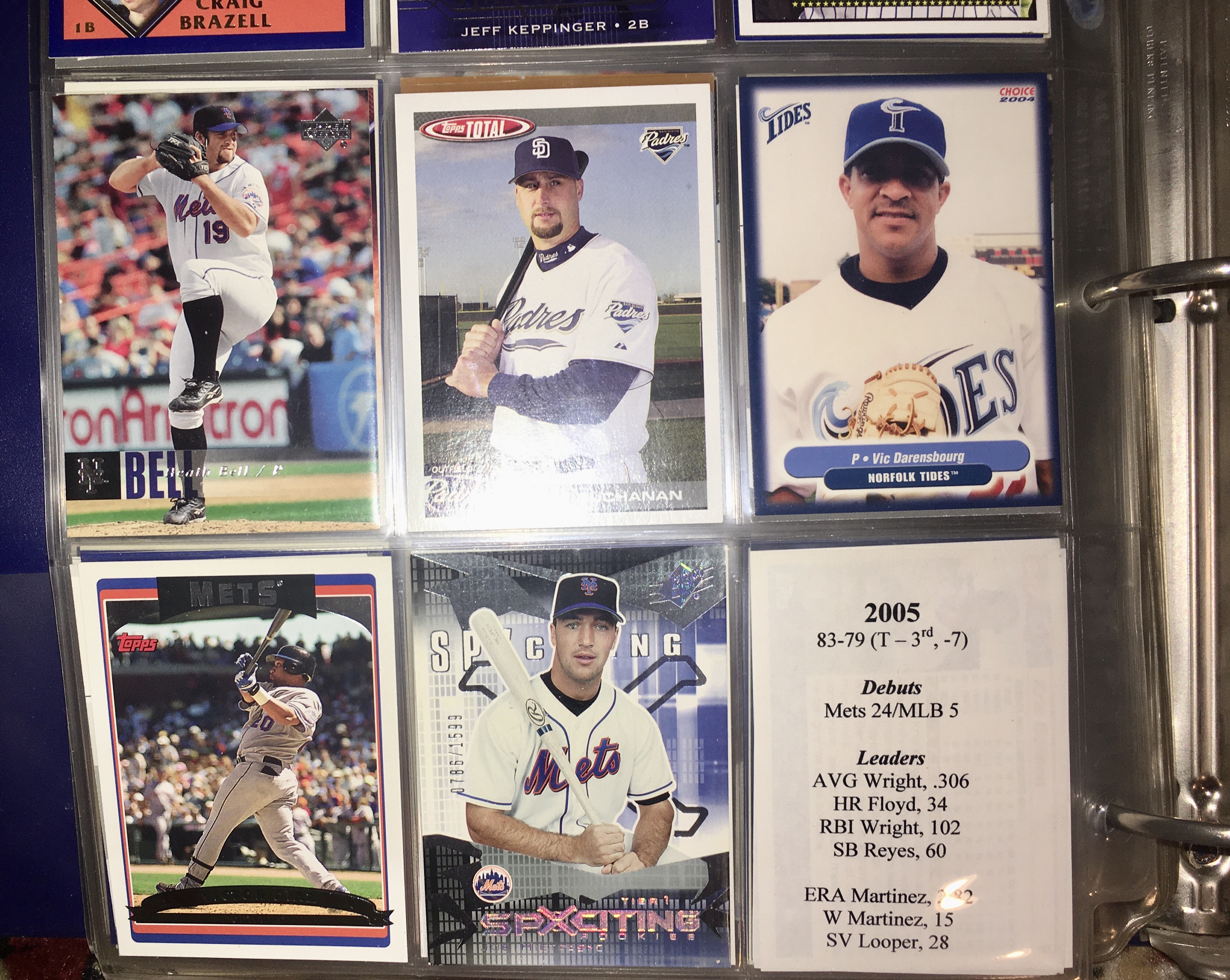
Not sure it was really spXciting, but he is in the book.
Which brings us to the curious case of Joe Hietpas.
Hietpas was called up in mid-September 2004, which was a strange time in Mets history. Art Howe had been fired but agreed to finish the season, which seemed pointless from the perspective of employer and employee alike. Hietpas was a catcher known for his receiving skills and a rifle arm, though he’d never hit in the minors. Somehow Hietpas hurt himself despite having nothing to do; updates on his status were perhaps understandably scanty. All I knew was the remaining games on the schedule were dwindling with no sign of Hietpas in a box score. Howe might not have lit up a room as promised, but he was universally hailed as a genuinely nice man; surely he wouldn’t let Hietpas’s opportunity pass him by.
But the Mets’ season came down to one game, an Oct. 3 matinee at Shea against the Expos — who were themselves about to be extinct, snuffed out by the shameless Bud Selig and his contraction shenanigans. I was in the stands with Greg and two friends of his, and I remember that our neighbors included a surprising number of Expos rooters in tricolor hats. Without exception, they were treated with sympathy and kindness — they were seeing the curtain come down on their team, in the same ballpark and against the same opponent where that team had begun its life back in 1969. It was a vigil and a funeral and a protest all at once, and I couldn’t help wondering how I would have reacted, if our situations were reversed. I was pretty sure I would have gone wherever the Mets went, decked from head to toe in blue and orange and trying to memorize each and every pitch — and praying that somehow there’d never be a final out. That was possible, right? A team could keep getting hits and walks and getting on base and so keep annihilation at bay, playing on and on in defiance of its executioners, until common decency and an international outcry forced a different ending to be found.
(There was an odd coda to the Expos’ finale, by the way: Brad Wilkerson took part in an MLB tour of Japan after the 2004 season, making him the final man to wear a non-throwback Expos uniform in competition. Surely there was some diehard out there who figured out how to find those games in a dark corner of the Internet, refusing to abandon his or her post as the last Expo played on the other side of the world.)
The final game in Expos history unfolded as final games do — slowly at first and then too quickly. In the sixth, Todd Zeile — who was retiring, and had returned to his original position of catcher as a farewell — hit a three-run homer in what would be his final at-bat; in the eighth, John Franco faced two batters in what would be his final appearance as a Met. (The first batter singled, marking my last opportunity to grumble at Franco, but the next guy, future Met malpractice victim Ryan Church, fouled out to Zeile.)
I’d been mildly tickled by Zeile returning to catcher, but the novelty had worn off and I was now more concerned with a first than a last: The Mets were up 7-1, so Hietpas was rapidly running out of time. When forgettable catcher Wilson Delgado pinch-hit for Franco, I groaned. Seriously, Art? You’re a good man. Depart with a final good deed. Delgado singled home a run; I was annoyed anyway.
The top of the ninth, in all likelihood the final inning in Expos history, began with an announcement — Bartolome Fortunato was now pitching. And now catching … yes, it really was him. Joe Hietpas had arrived.
You couldn’t see him — the mask and the late-afternoon shadows took care of that. (Honestly, it could have been anyone back there.) But I took it on faith.
The inning began with an Expo reaching on an error and another Expo getting on base via a walk. But Fortunato struck out the next two guys, and Endy Chavez hit a 3-2 pitch — the 24th thrown to Joe Hietpas in the big leagues — to Jose Reyes at short. The season was over, and the Expos were no more.
Hietpas — the Mets’ own Moonlight Graham — would be back in Double-A for 2005, and hit .216. He was no more of an offensive force the next season, but he did discover a new skill, hitting 93 in a stint as pitcher of last resort. The next season, he sought to extend his career by becoming a pitcher full-time — one whose repertoire included a knuckleball, because at that point why not?
Hietpas logged a 2.47 ERA for St. Lucie in 2007, and I let myself imagine him becoming a star reliever, or maybe, slightly less unrealistically, a useful specialist. Perhaps he’d even finally get that first plate appearance somewhere along the way. Hietpas pitched in Double-A in 2008, but this time his ERA was 6.34. Thus ended the dream, and Hietpas’s career.
But he was no ghost — no ectoplasmic asterisk with an unhappy sequel. Hietpas may not have ever wielded a bat in big-league anger, but he’s in Baseball Reference — the 16,208th player in MLB history, no less. Sure, his big-league career was only eight or nine minutes, but it counted. On a day full of endings, Hietpas experienced his own ending. But he had a beginning too. And wherever he is, I hope it’s one he cherishes.
PREVIOUS METS FOR ALL SEASONS
1962: Richie Ashburn 1964: Rod Kanehl 1966: Shaun Fitzmaurice 1969: Donn Clendenon 1970: Tommie Agee 1972: Gary Gentry 1973: Willie Mays 1977: Lenny Randle 1978: Craig Swan 1981: Mookie Wilson 1982: Rusty Staub 1983: Darryl Strawberry 1990: Gregg Jefferies 1991: Rich Sauveur 1992: Todd Hundley 1994: Rico Brogna 1995: Jason Isringhausen 1996: Rey Ordoñez 1998: Todd Pratt 2000: Melvin Mora 2001: Mike Piazza 2002: Al Leiter 2003: David Cone 2005: Pedro Martinez 2008: Johan Santana 2009: Angel Pagan 2012: R.A. Dickey 2013: Wilmer Flores 2014: Jacob deGrom 2019: Dom Smith
The first win after one of those lengthy losing streaks always makes me feel a little sheepish.
The Mets won. A spot of bother aside, it wasn’t even all that tense. And this after you spent five days being snarly and surly. Wasn’t that silly?
Well, of course it was. But my goodness, it really looked like they were all drowning, didn’t it? No one could hit. The relief corps was reliably horrific. And then on Sunday they managed to step on their own collective dick again in dealing with a personnel matter —
Nope. We’re not going to go there. That was part of the losing streak. This is a new week. A new beginning, even!
Of course it’s easier to be optimistic when you can throw Jacob deGrom at a problem. DeGrom was even nastier than usual Monday night, throwing his usual 99 MPH gas complemented by a slider and change, but this time he also showed up for work with a solid curveball — his fourth-best pitch and a work in progress, and so usually limited to cameos. What must that have been like in the Braves dugout? Oh great, he’s figured out a curveball too. Well, this will be fun.
It wasn’t fun for them; it was fun — for a change — for the Mets, whose players hit, hit when it actually mattered (now there’s a concept) and ran the bases alertly and aggressively. Robinson Cano and Michael Conforto were your stars on offense, but Wilson Ramos also hit a home run and everyone seemed more on point than they had in recent days. Even Pete Alonso looked patient at the plate, at least, even if that patience yielded nothing.
By the way, kudos to Gary, Keith and Ron for breaking down a hitch that’s crept into Alonso’s swing. As always, my hope is that if the TV guys see something like that, someone’s communicating it to people in the actual clubhouse for scrutiny. Sticking with SNY, though, something that’s stuck in my craw for some time reared its head again Monday. Next time you watch the Mets, notice what happens with the shift. Keep track of how often Gary, Keith and Ron note balls hit against the shift that go for hits, and how much time is spent kvetching about those plays. And keep track of how often balls that would have been hits without the shift are corraled into outs, and how little attention they get. It’s an excellent example of confirmation bias, and a blind spot that the best booth in baseball is far too good to allow to persist.
Hopping off my soapbox, deGrom was superb except for the fifth, when he had trouble commanding his offspeed stuff and got hit around a bit, most notably by old friend Travis d’Arnaud, who homered. The last home run surrendered by deGrom was also to an old teammate — Wilmer Flores. When deGrom actually gets in trouble it’s sobering and lends a bit of perspective — rather than be mad at him or for him, I tend to wax philosophical, musing that pitching must be really, really hard if even Jacob deGrom sometimes has trouble with it.
(By the way, I never want bad things to happen to the Mets. But if they must happen, I don’t mind d’Arnaud being their agent. While d’Arnaud never managed to fulfill his promise as a Met, he deserved better to be cast aside in a Wilponian hissy fit last spring. His beating the tar out of his old team the last few days suggests that the arc of baseball’s moral universe really might bend toward justice.)
Anyway, the Mets bullpen came in and started by doing recent Mets bullpen things, which was not what any of us had in mind: Jeurys Familia was the culprit this time, allowing a one-out single, double and walk. Up came Ozzie Albies, who could bring the Braves within one and leave us all hiding behind the couch until someone whispered that Alonso is doing PSAs thanking all the vaccine researchers who helped us get back to work and we could come out now.
But Familia got Ozzie Albies and yielded the mound to Justin Wilson, who coaxed a groundball to Alonso from serial Mets killer Freddie Freeman, and the peril was largely past. Newest Met Jared Hughes, a tall smiley sinkerballer who likes to sprint in from the bullpen, finished up and the Mets were back in the win column.
Back in the win column with an asterisk, if you want to be a downer about it — Jeff McNeil was a late scratch with a back issue, while Amed Rosario and Cano both departed early with tightness in various things. We’ll see what that means — “tightness” is one of those diagnoses that can range the gamut from acute and precautionary to chronic and disastrous. (Atlanta’s Mike Soroka, on the other hand, tore his Achilles tendon on an awkward step off the mound — an awful thing to see and a blow to the sport when it needs every young star who’s fit for duty.)
For now, let’s hope that asterisk is written in pencil, and the Mets can stay in the win column for a while. And if not, well, every fifth day we get to watch a master at work. Which is a pleasure and a privilege, whatever the standings say.
I nodded off briefly during Sunday’s game. I debated going for a full-blown nap, but thought, nah, this is the first Sunday afternoon the Mets have played this season. I gotta sit up for this. Still, against the backdrop of the Mets playing as they are in what this season is, a nap was probably the better choice.
Therefore, I sort of salute Yoenis Cespedes for opting out while the opting is good. Sleep this season off. We’re all going to wish we had. Maybe next time virtually reach out and touch somebody who needs to know that you plan to proverbially grab some shuteye. Not all protocol comes out of a hastily compiled manual.
Yo isn’t taking a nap, exactly. He’s opted out of 2020, which is something numerous players have done. First, however, he opted out of Sunday’s game in Atlanta, which is something you just don’t do…unless you’re Yo and a different drummer has driven you to your dizzying professional heights in the first place. Either way, he wasn’t in the lineup and his unanticipated absence from active duty in these socially distant times — expanded roster; players spread responsibly through otherwise unoccupied stands; no reporters in the clubhouse — probably would have gone unnoticed up in New York unless a pinch-hitting opportunity cried out for his .161 bat. Yet the Mets were never seriously a single vintage Cespedes swing from getting back into what became their fifth consecutive loss, so if nobody had gone out of their way to inform us that Yoenis hadn’t joined his teammates for a sleepy afternoon defeat at Truist Park, I doubt our not knowing his Sunday status until later would have bothered many of us.
Ah, but the Mets wouldn’t be the Mets without remotely tapping their devoted acolytes on the collective shoulder when they want to let us know we should think less of somebody they pay. Their game against the Braves was barely underway when they released a statement laced with mystery and speckled with incomplete information.
“As of game time, Yoenis Cespedes has not reported to the ballpark today. He did not reach out to management with any explanation for his absence. Our attempts to contact him have been unsuccessful.”
If the Mets hadn’t planted the possibility of god knows what in our heads, their missive would have merely evoked the old George Carlin bit in which the sportscaster gives “a partial score from the West Coast: Los Angeles 6.” In this case, though, leaning in to tell us they didn’t know where one of their players was didn’t land as terribly amusing.
After the 4-0 loss was over (David Peterson pitched six credible innings; the Mets left thirteen runners on base), Brodie Van Wagenen took to Zoom, as a general manager does in a pandemic, and revealed that while Yo was OK, he was no longer among us. That is he was no longer with the Mets. His hotel room contained neither his stuff nor him. Yo eventually got around to having his agent tell the Mets he was opting out from this thin semblance of a baseball season due to COVID concerns, effectively ending his Met career less than two months before his contract expires. Enough baseball players have “opted out” that we use the phrase like we use “the Mets didn’t hit in the clutch” or “the Mets lost again” in casual conversation. Opting out is sadly ensconced in our 2020 baseball language. So are COVID concerns, which are hardly abstract. You saw less of the Marlins and Cardinals this weekend than you did Yoenis Cespedes.
This rather sudden if somehow not shocking parting of the ways could have been communicated better from every angle. Cespedes should have at least sent Luis Rojas a text or answered one his manager sent him. The Mets should have waited for definitive word before clearing their throats, and then simply wished their now former star player good health and happy trails once they were up to speed. Instead, Yo is left looking a mile shy of the conscientious co-worker, while the Mets are in the familiar position of appearing to attempt to poison the atmosphere surrounding an employee they wish to turn public sentiment against.
Whatever motivated the timing behind his actions and exit, I simply wish Yoenis Cespedes good health and happy trails. I thank him for the joy he generated starting right around this moment in 2015. It lasted nearly three months and will stay with me for whatever remains of my lifetime; five years later, it endures as the only sustained outstanding stretch of baseball this franchise has produced since moving into Citi Field. Failure to adequately relay his whereabouts to his employer on a given Sunday isn’t gonna change what I think of when I think of Yo.
I also wish the Mets would conduct a more thorough head count before departing the hotel for the ballpark and, if they’re not sure where somebody is, they find out before disseminating their uncertainty as breaking news.
The Mets, having played interminable games wrecked by terrible relief pitching, at least found a new formula for a loss Saturday night — bad starting pitching coupled with a lack of offense when desperately needed.
Michael Wacha gave up a two-run homer to the increasingly unbearable Marcell Ozuna in the first, then surrendered three straight two-out hits in the second, further hindered by yet another play not quite made in the Mets outfield. That made it 5-0 Braves, more than they would need on a frustrating night for Met hitters in general and Pete Alonso in particular.
In the third, the Mets had runners on first and second with one out; Alonso grounded into a double play. In the fourth, the Mets put runners on first and second with nobody out; Yoenis Cespedes struck out. Dominic Smith walked, potentially reviving the inning; Wilson Ramos struck out and Amed Rosario grounded out. In the fifth, the Mets put the first two runners on again; Alonso struck out, again. Michael Conforto singled to load the bases and bring up Robinson Cano, the only potent bat in the lineup so far this year. He hit a sharp liner, but that was good only for a sacrifice fly that proved the sum total of the offense. (I could go on, as there were other episodes of, well, bat-teasing, but honestly that’s enough to recall.)
The bright spot, if you squint, was that Franklyn Kilome logged four innings in his debut and looked pretty good, particularly once he settled in a bit and the nerves stopped jangling. Kilome came over from Philadelphia when the Mets traded away Asdrubal Cabrera and pretty much immediately needed Tommy John surgery, but on Saturday night his arm looked live and his motion easy. The Mets could certainly use someone like that, given that even the reliable members of the bullpen have turned arsonist.
But I dislike squinting. The Mets could also use better starting pitching, hitters shaking off the rust and guys who can actually play defense. It’s a long list.
The Mets have lost four in a row, which Twitter’s mathletes would like you to know is the equivalent of a 11-game losing streak in this compressed sprint of a season. That neither true nor helpful, but the reality is bad enough: It’s August 2, the Mets are a mess, and so far their only victory of note has come in COVID testing, which isn’t the kind of win to crow about given how quickly and dramatically things can change.
The author Don DeLillo once wrote that “nostalgia is a product of dissatisfaction and rage,” a line I love and think is a useful corrective for baseball, where syrupy sepia always threatens to drown the pleasures of the present day.
But if you’re a Met fan who isn’t dissatisfied and at least rage-adjacent, I’m not sure what you’ve been watching for the last few days. So go ahead and get nostalgic. Back when we weren’t sure there’d be a season at all, Greg and I started penning A Met for All Seasons, in which we picked a player for each year of Mets baseball, sifted through our memories of that player, maybe even did a little research, and started typing.
We’re now halfway through that journey, having just chronicled 2001 and Mike Piazza. Before Big Mike, the year and player in the spotlight was 1983 and Darryl Strawberry. We’ve discussed Hall of Famers and 25th men, guys whose uniform numbers will never be worn by a Met again and guys whose uniform numbers are recalled only by the hardest of hardcore fans. So if another key strikeout or another act of bullpen malpractice leaves you fuming — or if an unfortunate test should push the Mets into baseball’s increasingly crowded PPD column — put aside DeLillo’s warning and join us for a stroll through Mets history.
DeLillo followed his line puncturing of nostalgia with another pretty good one: “It’s a settling of grievances between the present and the past.” Fair enough, but I’ve got grievances a-plenty with this particular present, and if current Mets are incapable of settling them, I’ll look to their forebears to soothe me, at least a little.
Some unusual Met things you’re pretty sure you’ve lived through before. There’s a lot of that going around, actually. In the case of the Mets blowing a large lead when they’ve posted double-digit runs, that’s too familiar a sensation to count in the camp of “Gosh, I’m certain this has happened before, but I just can’t remember when.” Of course you’re certain. It happened the contemporary baseball equivalent of barely more than a month ago. On September 3, 2019, the Mets built a lead of 10-4 and lost to the Nationals, 11-10. Thus, when on July 31, 2020, the Mets built a lead of 10-5 and lost to the Braves, 11-10, it hardly qualified for placement under the heading of Déjà Vu All Over Again. When you follow roughly the same trajectory and lose by the exact same score for a second instance in the span of 33 regular-season games, it falls more in the category of what you do.
Two of the Mets’ fourteen most recent regular-season defeats have been inscribed into the Book of Life as Somebody Else 11 Us 10. I’d say, “think about that,” but don’t. You have enough problems.
Some Met things, however, you have a hunch you’ve never lived through before — and that’s putting aside every baked-in bizarro aspect of 2020. I know we’ve sat through some long-ass games, but something about the past three have been particularly unending and unsatisfying, so I turned to Baseball-Reference’s Stathead service (a spiffy update of their former Play Index); fed in a couple of data points; and confirmed my suspicion.
Until this week, the Mets had never lost three consecutive nine-inning games that lasted longer than three-and-a-half hours.
I know it seems like all we do is sit through interminable affairs that yield intolerable results, but what we’ve experienced from Citi Field versus the Red Sox Wednesday and Thursday and Financial Merger Facility versus the Braves Friday is unprecedented in a very specific and very dispiriting way.
Wednesday: 3:44 to play nine innings and lose to Boston, 6-5. Thursday: 3:49 to play nine innings and lose to Boston, 4-2. Friday: 3:35 to play nine innings and lose to Atlanta, 11-10.
The Mets are scheduled to play only sixty games, but they seem determined to cram 162 games’ worth of inaction into them.
We didn’t need extras and we didn’t have to struggle to stay awake for the sake of the West Coast. This was simply regulation long and regulation awful over and over and over. Their only saving grace was they started and somehow ended in prime time. If three nights like these don’t cure you of your giddiness to have baseball back, the next Mets game that refuses to cease or sate or both ought to inoculate you. Surely there’s another one right around the corner.
Remember when you missed baseball? Me neither.
Remember when you looked forward to baseball? I do. Right around seven o’clock Friday night. It felt good to have a baseball broadcast or two clear its throat the way a baseball broadcast does on a Friday night. Even amid a calendar whose days have blurred into one another for months, you can still pick out a Friday night in summertime. If you can’t, it’s the one with most likely a brand new series between the Mets and somebody you can’t wait to beat getting underway in a few minutes. It’s how weekends have been meant to commence since 1962.
It’s exciting. Then it’s assuring. Then, you notice, it’s gone on a while but not really getting very far. Then it’s nine o’clock and it’s only the fifth inning? Maybe it’s nine o’clock. Maybe it’s the fifth inning. Baseball likes to boast that it doesn’t run on a clock, but when you used to be able to go to ballparks, you saw clocks. When you looked at box scores, near where they kept the paid attendance, you saw time of game. Time doesn’t stand as still as we like to believe it does during a ballgame.
Unless you’ve been watching the Mets this week. These past three games, time has squirmed in its seat, never finding a position in which to feel remotely comfortable. Even when you have Jacob deGrom on the mound. Even when you’re loading the bases. Even when you’ve constructed a robust lead.
With these Mets, robust tends to go bust. On Friday, the Mets were not only ahead, 10-5, they’d been ahead, 8-2. A six-run lead. A five-run lead. Expansive by any measure, right? With matters so securely in hand, all you were left to ponder was which Mets pitcher would be credited with the Mets win, because a) the Mets — powered in particular by J.D. Davis and Robinson Cano — were obviously gonna win; and b) Rick Porcello didn’t last five innings, which, even in 2020’s wonderland of distorted and truncated rule revisions, you still need to go five innings to get a win as a starting pitcher. Porcello couldn’t get out of the fifth despite being staked to a six-run advantage.
That might have provided a clue that we’d have bigger issues than assigning W’s. The Braves scored three in the fifth off Porcello and Paul Sewald. They added another off Chasen Shreve, though Shreve was generally effective and the Mets were adding a couple more tallies of their own (Amed Rosario loves hitting in whatever the Braves call their park in whatever part of Atlanta it isn’t in). Wanna give Shreve the win? That would be fine.
Entering the bottom of the eighth, the Mets were leading, 10-6. No pitchers needed to be pinch-hit for because the National League no longer exists in such a natural state, yet the Mets were on their fourth pitcher of the night, Dellin Betances. In brief, it didn’t go well, and it went on extra long because two replay reviews ensued, neither of them amounting to a reversal of declining Met fortunes and both of them combining to eventually push the game into to its eighth half-hour.
Betances left with the Mets’ edge reduced to 10-8 and Braves occupying first and third. The mess was transferred to the normally reliable right hand of Seth Lugo. Like most relievers, Lugo conducts his business more cleanly when an inning isn’t already in horrifying progress. Like most pitchers, starting or relieving, Lugo is best served by a home plate umpire identifying strikes as strikes. Seth had to deal with Betances’s runners and getting squeezed by Mike Wegner. We don’t make excuses for Seth Lugo, but we do try to cut our best reliever of the past two years some slack.
Still, when he got to a bases-loaded, two-out situation and the opposing batter was Travis d’Arnaud, we had to know what was coming. I assumed d’Arnaud knew what was coming, given that he was Lugo’s catcher fairly often as a Met. Multiply the vengeful ex-Met factor (Adeiny Hechavarria had led off the inning with a single) by the battery-familiarity factor and, yup, Travis d’Arnaud, whom the Mets let go with not much more than a second thought last year, doubled home three runs. The third of those runs put the Braves ahead, 11-10, the official score of you’ve got to be kidding me.
Nope, no kidding. No victory. No good at all, really. An individual exploit here or there notwithstanding, it’s hard to get enthused over being 3-5 after eight games. We knew that back when we could only imagine what it would feel like to be 3-5 after eight games. Except we can, for the first time in the history of Metkind, say we saw three consecutive nine-inning Met losses that lasted more than three-and-a-half hours apiece.
I didn’t say we’d want to say it, I’m just saying we can.
Welcome to A Met for All Seasons, a series in which we consider a given Met who played in a given season and…well, we’ll see.
True confessions time: When the rumor surfaced in the spring of 1998 that the Mets were about to acquire Mike Piazza, I was against the idea. Vehemently against it, in fact. The Mets, I railed, already had a perfectly good catcher in Todd Hundley. Sure, his elbow was shot, but he’d be back soon. The Mets had holes, but they didn’t need Mike Piazza.
I could slip that one into the memory hole, but I’ll own it, and admit — as I did within a few weeks — that I was being ridiculous. Hundley had set a club record for home runs, finally taking the Mets into 40-homer single-season territory. He’d shown admirable toughness and supplied some much-needed star power during one of the Mets’ sadsack periods. But — for God’s sake, Jace — he wasn’t Mike Piazza.
Nobody was Mike Piazza.
Piazza arrived and immediately gave the Mets a jolt in New York City awareness and the standings. The idiot wing of our fanbase hazed him on his arrival, booing him for merely being very good instead of fantastic, but he and we got over it and he settled in to become the emblematic player of his Mets era. Thinking about “the Mets in black” is a great way to visit with some old friends — Robin Ventura, Al Leiter, Cliff Floyd, John Olerud, Edgardo Alfonzo, Bobby Jones, Benny Agbayani, Rey Ordonez — but if you think of one guy from that era, odds are you’re thinking of Piazza.
But let’s go back to May 1998. The 29-year-old player they were acquiring was coming off a season in which he’d hit .362, socked 40 home runs and driven in 124. Those were videogame numbers — and he’d put them up in a pitcher’s park while squatting for three hours a day.
They were also the latest chapter in a story that seemed too unlikely to be true.
If Horatio Alger had written Piazza’s tale, he would have tweaked a few things. Piazza didn’t learn baseball wearing a milk-carton glove or dealing with a rock-strewn field — his upbringing was pretty much the opposite of that. He was a rich kid, and one with enviable family connections.
His father had grown up in the Philadelphia suburbs with Tommy Lasorda, six years his senior. Lasorda was Norristown, Pa.’s golden boy, clearly destined for baseball glory; Vince Piazza was his loyal sidekick (and a distant cousin). Lasorda became Walter Alston‘s successor as Dodgers Skipper for Life, while Piazza, a born wheeler-dealer, became a wealthy selling used cars. Mike was the Dodgers’ batboy when Lasorda’s team came to Philadelphia, and honed his skills in a batting cage built in the Piazzas’ backyard — one that eventually had a roof and a heater for year-round use. When Mike was 16, his dad arranged for Ted Williams to come by and watch his son’s batting-practice sessions and offer a bit of advice.
Piazza, then a first baseman, broke his high school’s home-run record (once held by Andre Thornton), but scouts were unmoved. Some of them said he couldn’t hit; all of them said he couldn’t run. Lasorda pulled strings and got Piazza into the University of Miami, but his freshman year as a Hurricane backup was a disaster; then, at his insistence, the Dodgers drafted him in 1988.
But they drafted him in the 62nd round, after 1,389 other players had been chosen. (Their top pick in that draft, Bill Bene, walked 489 batters in 445 minor-league innings.) Piazza was a courtesy pick, whom the Dodgers had no intention of actually signing — or of having play pro ball if they did expend a pittance as an additional courtesy. By all appearances he was … and I’m sorry to put this in your head … Jeff Wilpon.
The courtesy pick would get to suit up for pro ball, but only because Lasorda was his bodyguard, strong-arming anybody who got in his buddy’s son’s way. Which was pretty everybody drawing a Dodgers paycheck who wasn’t named Tommy Lasorda. The Dodgers reluctantly signed Piazza (for all of $15,000) after a tryout in Dodger Stadium, during which Lasorda told the team’s skeptical scouting director that Piazza was now a catcher.
So far, if we’re being honest, it’s a story that probably makes you feel a little queasy. But here’s where it gets interesting.
The rich kid had family connections, but he was also willing to work his butt off. Yes, he’d had a backyard batting cage, but he’d spent hours and hours in it, winter and summer. Tommy or Teddy Ballgame couldn’t drive balls into the Dodger Stadium seats for him — that was all Mike. And he now harnessed that same work ethic to learn to catch.
His first stop was Salem, where the results were probably better than expected but nothing eye-opening: Piazza hit .268 and showed a little power, but struggled defensively. So he asked to attend the Dodgers’ baseball academy in the Dominican Republic, language barrier and tarantulas for bedmates notwithstanding. (For two great reads on Piazza, here’s Kelly Whiteside from Sports Illustrated’s archives, and this book by some fella named Greg Prince.) He came back from the D.R. much improved as a backstop, but his 1990 season wasn’t too different than 1989, and for once his resolve faltered. Fortunately for fans in both L.A. and New York, Reggie Smith convinced him not to quit.
1991, at Bakersfield, was when things started to turn around — Piazza hit .277 with power, and his defense improved. And 1992 was his breakout — a .377 curb-stomping of the Texas League with San Antonio, a .341 tear through the PCL as an Albuquerque Duke, and a September callup to L.A. In 1993 he slammed 35 homers for the Dodgers, was Rookie of the Year, and became a baseball sensation. Besides the on-field heroics, his Littlest Allman Brother facial hair, deep brown eyes and easy smile helped make him a TV pitchman and a household name. (Something I’ve never found on YouTube forays, to my sorrow, is a wonderful ESPN “My SportsCenter moment” ad in which Piazza dreams of stealing home, to the shock of everyone from Dan Patrick to a cartoon character on a popcorn box.)
And then, improbably, he became a Met.
Emily and I were in the stands on May 23, 1998, a Saturday matinee against the Brewers, and the pregame buzz around us felt borrowed from a pennant race. Everyone in the nearby seats was talking excited with his or her neighbor, and there were periodic outbursts of apparently random cheering. Out beyond right field, you could see wave after wave of Mets fans arriving, disgorged from the 7 train. Piazza was late getting to LaGuardia, but the Mets gave us Diamondvision updates on his progress like they were NORAD tracking Santa’s sleigh.
He got a standing ovation, grounded out in his first Met at-bat, struck out in his second one, and came to the plate in the fifth with a runner on first, two outs, and the Mets up 1-0. Jeff Juden, the Brewers’ gigantic hurler, left a fastball out over the plate. Piazza whacked it into right-center and the ball kicked up dust and grass blades, then seemed to accelerate as it shot up the gap. My thought, borrowed from a bit of Mets’ spring-training chatter: A grown man hit that ball.
And Piazza kept hitting that ball, over eight seasons with the Mets that generated a slew of memories. The blast off the Yankees’ Ramiro Mendoza in the summer of 1999, which came down atop a tent 482 feet from home plate. The shot he struck off John Smoltz in Game 6 of the 1999 NLCS — the best game the Mets didn’t win — that tied the score at 7-7 despite Piazza only having one working thumb at the time. The rage I felt when Roger Clemens — who seemingly could never retire Piazza in a big spot — hit him in the head with a fastball, and then threw the shard of a bat across his path in the World Series.
Or how about the first-pitch line drive Piazza struck off Terry Mulholland earlier that summer, the one that capped the Mets’ 10-run inning, and came punctuated with an uncharacteristic fist pump and yell as he hit first base? I was in the park for that one, one of those indelible escape-velocity baseball moments in which a very long, agonizing buildup culminates in a single, electric second, with the pent-up emotion of the windup exploding all at once, like the detonation of a massive, joyous thunderstorm. That home run was 20 years ago, but it’s still atop my pinnacle of personal highlights, rivaled only by the Grand Slam Single. Leaping and yelling and screaming in the stands, I was briefly worried that I was having a heart attack, and then decided I was so happy that I didn’t care.
We all loved the home runs, of course, but there was something endearing about Piazza even when he wasn’t doing great things on the field. No matter how many RBIs he had, there was an inherent awkwardness to him. Some ballplayers seem born to the game, with perfect swings and fluid strides, but Piazza never struck me that way — he looked like he’d wrested greatness out of improbability through sheer repetitions. He’d stand stock-still at the plate, followed by a violent eruption of a swing, and then chug around the bases like a kid had made a flip drawing of a T. rex — legs and arms pumping energetically but with no particular efficiency. (The scouts were right about that part — he really couldn’t run.) He worked his butt off to be a serviceable catcher, but was never a great thrower or pitch-framer — his career came before pitch framing was in vogue, but I remember dissections of how Piazza lost strikes for his pitcher because he was a “window washer,” moving the glove to excess instead of holding it still for the umpire’s consideration.
He was a little awkward off the field too. No athlete was more excited to meet rock musicians than Piazza, and when he made a cameo onstage, he looked like you and I do air-guitaring in the privacy of our rooms. He had a goofy predilection for experimental hairstyles — after one horrible loss to the Cubs, he arrived for the next game with his hair cut short and dyed platinum, sparking a Wrigley Field ovation after shedding his helmet to chase a foul ball. Or there was the game where he got hit by a pitch, wound up holding it, and disdainfully tossed it aside. In the postgame scrum, he eagerly asked the reporters, “Did it look cool?” (It did.) I’m reminded of Eddie Van Halen’s confession when asked about being the guy on a million teenagers’ rock-god posters: “I am so much geekier than all those kids who want to be me.”
But let’s part with an indelible Piazza moment. It came in 2001, the year that’s his in our Met for All Seasons series. I was there on Sept. 21, 2001, the first ballgame played in New York City after 9/11. There were long waits to get into the ballparks (the Mets, being fan-friendly for once, delayed the start to accommodate the security lines) and once we were inside, I wasn’t sure if I really wanted to be there. It wasn’t that I was scared about something bad happening, though that was of course in the back of my mind. It was more that we were all still flattened by shock and grief, and trying to figure out how to move forward, and I had no idea if I had any reservoir of emotion to draw on for something as seemingly inconsequential as a Mets-Braves game.
There was a 21-gun salute and cheers for cops, fighters and emergency responders — and even for the Braves, who exchanged handshakes and hugs with the Mets. And then the game started. At first it barely registered, but the Mets and Braves gave us a taut thriller, one you couldn’t help but pay attention to.
Liza Minnelli, of all people, broke the emotional ice with a seventh-inning-stretch performance of “New York, New York” that I greeted skeptically at first, particularly when she assembled an impromptu kick line with the cops and firefighters. But if they didn’t mind, who was I to object? And she sang the absolute hell out of that old chestnut, filling it with all the love and wistfulness and defiant triumph I’d never noticed it contained.
We felt all that, and were able to let some of it out, and then the bottom of the eighth came, and Piazza arrived at the plate with one out, a runner on first, and the Mets down 2-1. He connected on an 0-1 count, forever immortalized by Howie Rose’s ecstatic yelp that “this one has a chance!” That call is a bullseye emotionally even if a little wide of the mark for accuracy — from my vantage point in the mezzanine, there was no doubt that it was gone the second Piazza connected. Before it cleared the fence, we were all on our feet screaming and hugging and celebrating.
I’ve thought about that home run a lot, and what it meant. The Mets didn’t win in 2001 — their season sputtered to an inglorious conclusion when Brian Jordan connected off John Franco in Atlanta not long after Sept. 21. And, of course, that swing of the bat didn’t bring anyone back who’d been lost, or shorten the long, painful road ahead of us — a road we’re still traveling, in some ways. But it’s not like anyone thought it could, or imagined it should.
What it did do was make it OK for us to imagine devoting ourselves to small things. It gave us permission to lose our minds about a baseball game and who’d win it. Which is far from nothing, if you think about it. We rarely find ourselves in the grip of world-shaking events; usually, we’re connecting the dots hour to hour and day to day. And there’s no shame in that, because most of our lives are small things. Piazza’s home run showed us a way to get back across the chasm that had been cleaved between the two. We weren’t going to forget what had happened, but we would be able to move forward. Maybe we didn’t know how, not just yet, but we knew we had a chance.
PREVIOUS METS FOR ALL SEASONS
1962: Richie Ashburn 1964: Rod Kanehl 1966: Shaun Fitzmaurice 1969: Donn Clendenon 1970: Tommie Agee 1972: Gary Gentry 1973: Willie Mays 1977: Lenny Randle 1978: Craig Swan 1981: Mookie Wilson 1982: Rusty Staub 1983: Darryl Strawberry 1990: Gregg Jefferies 1991: Rich Sauveur 1992: Todd Hundley 1994: Rico Brogna 1995: Jason Isringhausen 1996: Rey Ordoñez 1998: Todd Pratt 2000: Melvin Mora 2002: Al Leiter 2003: David Cone 2005: Pedro Martinez 2008: Johan Santana 2009: Angel Pagan 2012: R.A. Dickey 2013: Wilmer Flores 2014: Jacob deGrom 2019: Dom Smith
In what I suppose one could say is a sign of relative normalcy, I’m disgusted by the Mets and want them to go away.
No! Not really go away! But … well, sort of. Because I was so happy to have three hours of solace a night, and instead the last two nights the Mets have brought me three-plus hours of angst, frustration and finally out-and-out anger.
Don’t Drink Out of a Glass Because You Might Bite Through It anger.
Don’t Touch the Remote Because It Will Be Tempting to Hurl It anger.
It’s all fairly familiar, and I could go for the easy COVID “Nature Is Healing” joke here. Except I feel variously blistered and chafed and thoroughly irritable.
Wednesday night’s sloggy mess was long enough without extending it further in memory, so let’s just say that it sucked, and if you really want to revisit exactly how it sucked, Greg can supply all the masochism you apparently need. Thursday night was different in some ways but agonizingly the same in every way that ultimately mattered. On Wednesday the Mets hit except when it mattered; on Thursday they barely hit at all. On Wednesday Jacob deGrom was blameless except for his choice of employers; on Thursday Steven Matz was betrayed by poor location on key pitches, particularly to Red Sox catcher Christian Vazquez, whom I’d like never to think about again after what he did to us in this series.
In the seventh the Mets had the tying run on second with nobody out; Wilson Ramos grounded out, Brandon Nimmo struck out and Amed Rosario grounded out. In the eighth the Mets had the tying run on third with one out; Michael Conforto struck out. In the ninth … except oh wait, the bottom of the ninth only theoretically mattered because in the top of the ninth Edwin Diaz came in. He gave up two walks and a single, fanned Rafael Devers, then hit Jose Peraza to force in an insurance run the Red Sox turned out not to need.
Except wait — Diaz actually hit Peraza twice in the at-bat. No, I’m not kidding, and no, this is not another absurd 2020 wrinkle Rob Manfred decided might be the thing to make the kids stop with the texting and the TikTok and watch baseball. The first time, Diaz hit Peraza in the thumb, except he swung through the pitch so it was merely a very painful strike. Not to worry — he managed to do it again. I’d ask how that’s possible, except if you’d spun that scenario for me and asked me what Met it had happened to, I’d have looked at you unhappily and guessed it was Diaz.
Diaz was arguably unlucky in failing to lock down the season’s second game against Atlanta, when Marcell Ozuna hit a pretty good pitch (albeit a carbon copy of one Diaz had used earlier) for an opposite-field home run. But this night was on him. If there was a silver lining — and it’s an awfully faint one — after the game Luis Rojas did not offer some earnestly dim-bulb Mickey Callaway horseshit about Proven Veterans™ and their knowing the game; instead, he said that wasn’t the Diaz the Mets had seen in summer camp and suggested his struggles were as much about controlling his emotions on the mound as command and mechanics. That’s not the usual baseball omerta, which is refreshing; so is the possibility that Diaz won’t get another scholarship year as closer based on what he did in some arriviste minor league two seasons ago.
(Oh wait, though. If you’d asked me the hit-a-guy-twice question, the other pitcher I would have picked would have been Paul Sewald. Sewald came in after Diaz was excused further duty, and if this were a regulation July I really think I might have turned off the TV and read about it in the morning. So of course, baseball being baseball, Sewald recorded a strikeout and a flyout to exit unscathed. Will wonders never cease?)
If I squint and try to reason with the foaming-at-the-mouth WFAN caller in my head, I can see that the Mets aren’t actually far off — some bad luck here, some pressing at the plate there, some rust, some roles that need to be sorted. A couple of at-bats go differently over the last two days, and they just swept the Red Sox and we’re talking about revenge against the Braves.
But they didn’t do any of that. The honeymoon’s over and the apartment’s too small and our significant other is doing That Thing We Hate again, and we keep looking into the sink filled with dishes someone else should have done and wondering, with a sinking feeling that suggests we already know the answer, if this is going to work.
“Everywhere I went,” Marvin Gaye and, later, James Taylor sang, “it seems I’d been there before.” In that spirit of history either repeating or rhyming, I’d have to say that on Wednesday night, I kind of got what they were getting at.
On October 25, 1986, though the result didn’t go final until the earliest hour of October 26, the Boston Red Sox were defeated by the New York Mets in the village of Flushing, 6-5, despite holding the Mets to only eight hits while registering thirteen hits themselves; the visitors left fourteen runners on base. This happened to be the sixth game of the World Series, a Series the Red Sox had been leading three games to two. Those Red Sox were managed by John McNamara. At several junctures during that game’s tenth inning, McNamara was no more than one swing away from forever being known as the manager of the 1986 world champions.
On July 29, 2020, though the game felt like it dragged until October 26 (it went 3:44), the Boston Red Sox defeated the New York Mets in the village of Flushing, 6-5. This also happened to be the same day John McNamara, forever known as the manager of the 1986 American League champions, died at the age of 88.
On June 10, 2003, well-regarded Mets prospect Jose Reyes, hours shy of his 20th birthday, made his first major league start at shortstop in an Interleague game. Young Jose produced a pair of hits, including one for extra bases, in a Met loss.
On July 29, 2020, well-regarded Mets prospect Andres Gimenez, all of 21 years old, made his first major league start at shortstop in an Interleague game. He produced a pair of hits, including one for extra bases, in a Met loss. This also happened to be the day Jose Reyes, now 37, officially announced his retirement from a baseball career that encompassed sixteen seasons and myriad accomplishments.
In the 1950s, when they were both writing for Sid Caesar, newcomer Woody Allen was introduced as “the young Larry Gelbart,” to which Larry Gelbart quickly responded, “I thought I was the young Larry Gelbart.”
On July 29, 2020, as Andres Gimenez made his case to be thought of as the next Jose Reyes, 24-year-old Mets shortstop Amed Rosario, described during the night’s broadcast as Reyes’s protégé, watched Gimenez play at Citi Field from a socially distanced seat in the stands.
On August 28, 2015, in a game between the Mets and Red Sox at Citi Field, Mets ace Matt Harvey allowed only two hits over six innings, but Red Sox catcher Blake Swihart (2-for-4) ultimately upstaged his brilliance with an inside-the-park home run off reliever Carlos Torres. The ball actually left the park, but was mysteriously ruled to have done otherwise. Either way, the Mets wound up losing a game it felt like they should have won.
On July 29, 2020, in a game between the Mets and Red Sox at Citi Field, Mets ace Jacob deGrom allowed only three hits over six innings, but Red Sox catcher Christian Vazquez ultimately upstaged his brilliance with a home run off reliever Seth Lugo. The ball was definitely out of the park, but earlier, deGrom had Mitch Moreland struck out, yet his pitch was mysteriously ruled a ball, and after that at-bat continued, Moreland snapped deGrom’s long-running scoreless streak. Either way, the Mets wound up losing a game it felt like they should have won.
On too many nights to mention, deGrom deserved better than a no-decision in a game the Mets went on to lose.
On July 29, 2020, deGrom deserved better than a no-decision, and the Mets went on to lose.
In too many games to fully enumerate, I looked up at the line score midway through and wondered how the Mets could have so many hits yet so few runs and was certain they would pay for leaving so many runners on base.
On July 29, 2020, at the end of the sixth inning, the inning when Andres Gimenez tripled in Robinson Cano with the go-ahead run, I looked at the line score, and instead of being thrilled that the Mets were up, 3-2, I noticed the Mets had 10 hits and was pretty certain they would pay for leaving so many runners on base.
On September 15, 2019, with the Mets clinging to a one-run lead over the Dodgers, their manager counted on the oft-used Justin Wilson and Seth Lugo to keep them ahead late, and I had the feeling Mickey Callaway was going to each generally dependable well once too often. Wilson gave up the tie, Lugo gave up the lead, and the Mets lost by one run.
On July 29, 2020, with the Mets clinging to a one-run lead over the Red Sox, their manager counted on the oft-used Seth Lugo and Justin Wilson to keep them ahead late, and I had the feeling Luis Rojas was going to each generally dependable well once too often. Lugo gave up the lead, Wilson gave up the tie, and the Mets lost by one run.
On October 19, 2006, with the Mets down two runs in the bottom of the ninth inning, the ballclub that we love in spite of how much it can frustrate us began to mount an improbable rally against Cardinals closer Adam Wainwright. With runners on first and second and one out, Jose Reyes stroked a line drive into center field that looked certain to score at least one run and drive the Mets toward tying and potentially winning the National League Championship Series. Except St. Louis center fielder Jim Edmonds caught the sinking liner, impeding the Mets’ momentum in what was about to become, two batters later, a 3-1 loss that ensured the National League pennant would fly somewhere other than Shea. Had the 2006 Mets gone to the World Series, perhaps their manager, Willie Randolph, would have gone on to a lengthier managing career instead of never getting another shot after the Mets let him go in June of 2008.
On July 29, 2020, with the Mets down two runs in the bottom of the ninth inning — not long after I listened to a fascinating interview between Howie Rose and Willie Randolph touching somewhat on the disappointment of the Mets losing the 2006 NLCS — the ballclub that we love in spite of how much it can frustrate us began to mount an improbable rally against Red Sox closer Brandon Workman. With their deficit cut from two runs to one and the bases loaded with two out, Robinson Cano stroked a line drive toward into center field. It was more like a humpback liner that looked like it might make it into center field. Still, it looked like it was gonna fall in, maybe, at least until Boston shortstop Jose Peraza picked it out of the air without much trouble, snuffing the Mets’ momentum in what had become, as mentioned above, a 6-5 loss. The Red Sox scored their six runs on eight hits. The Mets scored their five runs on fifteen hits while leaving eleven runners on base.
Just because you get the feeling you’ve seen everything before, it doesn’t mean you won’t keep coming back to watch some more.
Every day of Improv Season 2020 is another moment to cock your head, say “huh” and try and figure things out.
Most of that’s been a little anxious. I know Citi Field well enough that just seeing its geometry was enough for my sense of familiarity to kick in and make me think, “I can work with this.” But Fenway without people looks eerie and feels shorn of its charm. It’s still a little bandbox, but there’s no lyricism — that comes from the people crowding into the too small seats and making their way through the crowded concourses and peering around the poles from another century.
But it’s not completely anxious. At least in small doses, the experiments are interesting. I hope expanded playoffs, the National League designated hitter and extra-inning runners on second are one-offs we won’t see again. But picking up yet-to-be-official suspended games from the point of suspension, instead of replaying them from the jump? Let’s keep that. Why did we spend all those years doing something strange, wasteful and punitive in the first place? As for the rest of it? I don’t mind so far — this whole season’s an exhibition. Just go with it, even if the outcome turns out to be unfair, weird or both. Or if there’s no outcome at all.
I do wonder, however, if some of the sloppiness we’ve seen so far this season is about more than understandably discombobulated players and abbreviated training times. It has to be bizarre to try and play baseball in a sonic and emotional void. Ballplayers are adrenaline junkies, riding its spikes in ways I think a lot of us would find terrifying. Does playing without the sounds of a big crowd and the attendant emotions mean a loss of focus on a crucial pitch, a slightly tardier first step on a ball into the gap, a blurring of tunnel vision when focus is what’s needed? I don’t know — maybe the players themselves don’t know yet — but I’m curious.
I’m determined to make it a cliche five days in, but the saving grace of Improv Season 2020 has been that the game’s still the game, even if the announcers and the fans are somewhere else.
For example, pitchers making their big-league debuts still look like they can’t get enough air out there when they need to throw that first pitch. Once he got that out of the way, though, David Peterson was impressive — none of his pitches is of a quality that would make scouts drool, perhaps, but you can see him thinking out there, mixing speeds and changing eye levels and working to outmaneuver hitters. His sinker kept sailing, but he adjusted, using his slider and change-up to make up for their rebellious sibling. For a game at least, Peterson reminded me of Dillon Gee, which I absolutely mean as a compliment. His scouting report may never advance beyond qualified praise, but I had faith that he’d get as much out of what he had as possible. A few guys with that profile succeed consistently, some rarely do, most have to live with equal portions of success and failure, but all of them are easy to root for.
(Next day addition: If you subscribe to The Athletic, Tim Britton does a wonderful job breaking down how Peterson attacked J.D. Martinez in two key ABs. And if you don’t subscribe to the Athletic, you should. Britton’s the best guy on the Mets beat, worthy of comparisons to the great Adam Rubin.)
The rest of the Mets looked … well, similar to how they’ve looked so far. As with the Braves series, there were a lot of windmill swings and overaggressive approaches, and too much sloppiness in the field. But one’s always harder on one’s own team than the opposition, because you’re painfully aware of the gap between what your team is and what you think they ought to be. The Mets look like they still need some tinkering, but the Red Sox look like a complete mess, with tomato-can pitching and a general listlessness to every aspect of the proceedings.
But again, it’s improv. Everyone deserves to be graded on the curve, at least until baseball figures out how this works. Assuming that’s even possible, which it may not be. For now, it’s strange rules and empty stadiums and remembering not to do half the little teammate things you’ve done for a decade or more, with other teams’ mandated blanks in the schedule as a reminder of what can go wrong.
We absolutely have to keep our eyes on that — and be honest about the cost-benefit analysis — but we can also enjoy the familiar things and the entertainingly unfamiliar things too. Home runs off the Pesky pole, balls played surprisingly well off the Green Monster, goofy rundowns following blown double plays that were everyone’s and no one’s fault, guys adding their signatures to the inside of the Fenway Park scoreboard, a rookie with a W and a game ball he’ll treasure forever? We can be grateful for those little moments even as we wonder and worry about the larger story.
Welcome to A Met for All Seasons, a series in which we consider a given Met who played in a given season and…well, we’ll see.
There’s a new world comin’
And it’s just around the bend
There’s a new world comin’
This one’s comin’ to an end
—Cass Elliot
If I have one certainty as a Mets fan, it’s that no Met will ever give us a more significant career as a Met than Tom Seaver. If I have a second certainty as a Mets fan, it’s that no Met’s promotion to the big leagues will ever mean as much to the Mets and their fans as that of Darryl Strawberry, coming as it did in 1983.
As of this moment, we’ve had 402 players make their major league debut as Mets. Bob Moorhead was the first. Andres Gimenez is the most recent. Seaver was the 39th. Strawberry checked in 140th. Moorhead didn’t mean much in the scheme of things. Gimenez we can only hope. As mentioned, no Met has ever been or ever will be more significant than Seaver. But when it comes to getting our hopes up, nobody has matched or will match Strawberry.
Nobody can. We looked forward to the arrival of Darryl Strawberry from the moment we’d heard of him and it occurred to us that all we had to do to have him was draft him and sign him. That was it. It wasn’t going to take a fancy trade. It wasn’t going to take the kind of free agent commitment to which the Mets had been allergic since big-ticket stars became available for the price of money. The 1979 Mets, unbuoyed by any kind of helpful acquisition, were at least clever enough to finish with the worst record in the National League, entitling them to make the first selection in the 1980 amateur draft (the privilege of picking first alternated by league in those days). They couldn’t call it tanking. The 1979 Mets finished worst on merit.
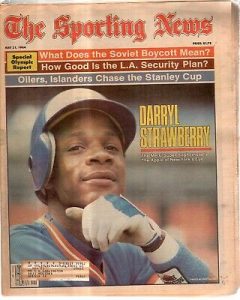
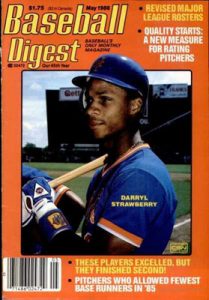
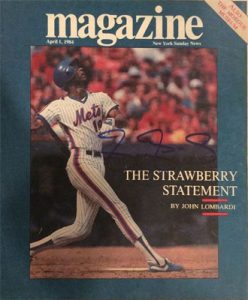
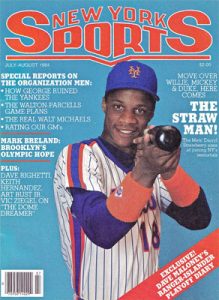
In the spring of 1980, there was little chance for a run-of-the-mill baseball fan to form opinions on scholastic players, not like there’s been for the past couple of decades at least. Maybe one name every few years would break into the general consciousness. Forty years ago, that name was Darryl Strawberry. Once you’ve seen a name like that, you’re not likely to forget it.
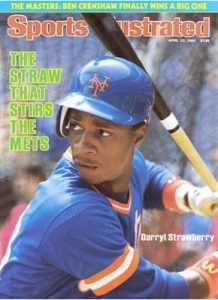
Picking up Sports Illustrated’s baseball preview issue that April, we could read about the “Stars of the ’80s” predicted to dominate the sport over the next ten years. On the cover was 1979 batting champion Keith Hernandez of the St. Louis Cardinals. He got a nice writeup alongside teammate Garry Templeton and other comers from across the NL and AL: Rick Sutcliffe of the Dodgers; Carney Lansford of the Angels; Paul Molitor of the Brewers; and Bob Horner of the Braves. The only Met mentioned among the “stars” was Nolan Ryan, in the context of not knowing which youngsters might make it big once they’d overcome their early difficulties. By 1980, Ryan was long an established superstar. He’d just been lured to Houston, becoming the first player to be paid more than a million bucks annually. You couldn’t forget that the Mets once had Nolan Ryan and traded him to California, where he’d spent eight seasons striking out most every American Leaguer he saw. You couldn’t imagine the Mets offering anybody of his ilk a multiyear megabucks contract.
In the predictions section of the magazine, the Mets were given two paragraphs of attention. They were envisioned as coming in sixth in the National League East for a fourth consecutive campaign. “Although New York should finish last again,” Larry Keith wrote, “there is hope for a brighter future, thanks to the ambitious new owners who bought the team for a record $21.1 million.” The Mets were given props for retaining Craig Swan (misspelled “Swann”) and Joel Youngblood as well as fixing up their stadium and clubhouse, but otherwise, “they haven’t substantially refurbished the lineup.” John Stearns chimed in, “Our problem is that we’ve been rebuilding for four years.” No wonder Mr. Keith finished his NL East preview with the parting shot, “while Pittsburgh is the team that everyone hopes to beat, New York is the team everyone will beat.”
That was on page 44. That was the present. But the future, if we embraced it correctly, awaited us on page 30. There, in a sidebar headlined, “Next Pick: Strawberry,” was a young man in a blue mesh ballcap and a mustard yellow top, clutching an aluminum bat. “Darryl, 18,” the caption read, “is likened to Ted Williams.”
You’re not likely to forget a comparison like that, either.
Darryl Strawberry was the one amateur player who stuck out above every other kid in the sport. You didn’t see anybody else getting folded into a package featuring Hernandez, Templeton, Molitor and so on. You did see the lede written by Joe Jares — “Darryl Strawberry may also be a star of the ’80s…” — and, if your team owned the No. 1 pick in all of baseball, you had to drool at the thought that someone who was compared to the last .400 hitter ever before you even got to the first paragraph could be ours. The brief article delved into the lefty swinger’s physical similarities to Williams, the qualities that made scouts giddy (“bat quickness”; “bat presence”; “a natural hitter”) and revealed that, oh by the way, he also pitched and excelled at a couple of other sports for Crenshaw High School in Los Angeles.
“I dream about being in the major leagues at the age of 20,” young Darryl told SI. “I dream about making it to the World Series at the age of 20 if I go to a good ballclub. And if I play well this year, I dream of coming out the No. 1 draft choice in the nation.”
Jares didn’t bother mentioning who held that No. 1 selection. Perhaps he thought injecting “the team everyone will beat” from page 44 into the idyllic scenario Strawberry was painting for himself on page 30 would be too much of a downer. But it didn’t take much for the reader, if the reader had a vested interest in accelerating the Mets’ chronic rebuilding program, to put No. 1 and this one together.
Now all it was going to take was these ambitious new owners to act appropriately.
***
As the draft approached, I knew only a few things about the Mets and drafts. First, they weren’t particularly great at negotiating them, certainly at the top end. True, the magnificent Seaver had come to the big leagues as a Met, but implicit within the legend of how the Mets got him — the Braves inadvertently skirted a rule regarding amateur eligibility while Tom was at USC and, one fortuitous drawing out of a hat later, he was ours — is that the Mets didn’t draft him. They didn’t draft that many of the eventual 1969 Mets who came up through their system. True, they scouted well to find Ed Kranepool, Cleon Jones, Ron Swoboda, Tug McGraw, Bud Harrelson and Jerry Koosman, but they all predated the draft. Once baseball decided it would be fairest to put every team on something approaching equal footing, with last year’s worst teams annually picking first, the New York Mets, about as bad as any team had ever been year in and year out, didn’t fully take advantage.
Picking second overall the first year of the draft, in 1965, the Mets selected pitcher Les Rohr.
Picking first overall the second year of the draft, in 1966, the Mets selected catcher Steve Chilcott.
Rohr got hurt. Chilcott got hurt. Between them, they played in six major league games, all of them Rohr’s. With Seaver, Koosman and later-round draftees Ryan (10th round of 1965), Jim McAndrew (11th round of 1965) and Gary Gentry (third round of 1967), the Mets had enough young pitching to cover for Rohr’s shortfall.
Chilcott was a different story within the context of Met mythology. He’s the player drafted by the Mets ahead of Reggie Jackson. There’s more that can be said to perhaps rationalize the choice, but when you learned as a budding Mets fan in the 1970s that “they picked Steve Chilcott over Reggie Jackson,” it was “enough said”. I knew sometimes the Mets made a good choice with their first pick (Jon Matlack in 1967, Lee Mazzilli in 1973) or a decent choice with their first pick (Tim Foli, No. 1 overall in 1968), but mostly I knew they picked Steve Chilcott over Reggie Jackson.
And that they’d picked Randy Sterling with their first selection of 1969. And Rich Puig in 1971. And Richard Bengston in 1972. And Cliff Speck in 1974. By 1980, I was still waiting, to varying degrees, on the returns from the “future stars” likes of Butch Benton (1975), Tom Thurberg (1976), Wally Backman (1977) and Hubie Brooks (1978). I was definitely enthused that UCLA hot shot starter Tim Leary (a righty, like Seaver) had been picked first by us and second overall in 1979. Maybe he’d be here soon.
But I also knew that the Mets had never picked anyone like what Darryl Strawberry was supposed to be…and, from reading the papers leading up to the June 1980 draft, that they were thinking of picking somebody other than Darryl Strawberry.
A couple of years before, I asked my mother if we could get a bicycle pump. I rode a lot, she rode a lot, it seemed like a good thing to have in the house. Sure, she said, she’d go to our local bike shop, Kreitzman’s, and pick one up for us. I envisioned a regular bicycle pump, like the one that Kreitzman’s let us use when we’d wheel in a little low on air. I didn’t know how else to describe it. It was a bicycle pump.
My mother came home with something else. This, she said, was what Mr. Kreitzman said was the latest in bicycle pumps, from Japan or Europe or somewhere exotic. Having patronized Kreitzman’s for as long as I can remember, I’m sure Mr. Kreitzman was being honest. They were good people. But I gotta tell ya, the damn thing was not a bicycle pump, not in the sense that you could use it to easily inflate your bicycle tires.
“Why,” I thought to myself, “can’t we ever just get the normal thing everybody else would get?”
I thought the same thing as the 1980 draft neared. The Mets are thinking of picking somebody else? Somebody other than Darryl Strawberry? Somebody other than the next Ted Williams?
Yes, apparently they were also taken by another young man from California by the name of Billy Beane. Like Strawberry, he was an outfielder. Like Strawberry, he was said to be quite talented. Unlike Strawberry, he wasn’t Strawberry.
Jesus, ambitious new owners, don’t let us down. Please bring home the right No. 1 draft choice.
To my Chilcottian surprise, they did. On June 3, 1980, Frank Cashen, the GM Nelson Doubleday and Fred Wilpon hired to rebuild the Mets to John Stearns’s specifications and then some, selected, with the first pick in the nation, Darryl Eugene Strawberry of Crenshaw High School in Los Angeles. Not only did they not blow it at No. 1, they got lucky later in the first round. Because they were owed compensation for losing Andy Hassler as a free agent, they got to pick at No. 23, and sitting there for the satisfaction of the internal Strawberry doubters was Beane. And, to fill out their portfolio a little more, with the first-round pick at No. 24, a product of having lost Skip Lockwood to free agency, they grabbed a catcher named John Gibbons. The draft wasn’t covered as it is today, but you heard about this first-round bounty. We got three players where it had seemed annually we got none.
Mostly we got Darryl Strawberry. He visited with the big club while they were on the West Coast later in June, meeting and posing with manager Joe Torre. He was officially signed in July and was assigned to Kingsport. Newsday sent a writer down to Tennessee to report back on his professional debut. The folks running our Appalachian League affiliate were handing out strawberries by the pint.
We in New York couldn’t eat up news of Strawberry’s development fast enough. From “are we gonna draft him?” we pivoted to “when is he gonna get here?” It was the summer of 1980. We understood it wasn’t going to happen immediately, and besides, we were reasonably preoccupied with the whole Magic is Back vibe permeating Flushing. But by September, the Mets had returned to “team everyone will beat” status (we finished next-to-last) and as Darryl was turning 19 in March of 1981 and 20 in March of 1982, our Strawberry yen was only intensifying. The ballclub that high school Darryl hypothesized might be good enough to add him to its World Series roster ASAP wasn’t anywhere near fruition. He might have helped a contender even then. In 1982, Darryl Strawberry of the Jackson Mets tore up the Texas League, scorching Double-A pitching for 34 home runs, 97 runs batted in and a .283 batting average. Stole 45 bases as well, because that was something he could do, too.
In 1982, the season after they fired the no longer Magical Torre, the New York Mets without Darryl Strawberry won 65 games and lost 97. They called him up in September, but just to give him a Doubleday Award, the prize the organization inaugurated just that year to recognize minor league achievement. A nice gesture, but we’d seen plenty of minor league achievement at Shea Stadium in 1982. And 1981. And 1980. And 1979. And 1978. And 1977. Managers changed. Owners changed. The ballpark had been painted. Swell. What we needed most was a major improvement in 1983. Darryl Strawberry was about to turn 21 and the endless rebuilding initiative was getting very, very old.
***
The signal event in ruining the New York Mets from 1977 onward was the trade of Tom Seaver on June 15 of that year. To be fair, the Mets were already miserable when Joe McDonald pulled the trigger of the gun M. Donald Grant ordered him to point at the lower-case franchise’s head. They’d fallen fifteen games under .500 by late May, costing the Joe before Torre, Frazier, his job as manager. It’s hard to fathom that holding onto the upper-case Franchise would have meaningfully slowed the late ’70s Mets descent into the competitive abyss.
Nevertheless, trading Tom Seaver made everybody more miserable, and the cloud that moved in over Shea Stadium never fully dissipated until April 5, 1983, the day Tom Seaver returned to the mound to pitch in home pinstripes. No longer was Tom Seaver clad in Cincinnati red. This was Seaver like he oughta be. When No. 41 emerged from the right field bullpen, and close to 49,000 Mets fans stood and cheered, the Magic was as Back as it could be.
Seaver was back. In a way, the team from which he was inexcusably exiled had left a light on for him. On the 1983 Mets that Opening Day were a surprising number of survivors or at least recidivists from Seaver’s extended first term in Flushing. Ron Hodges was catching him. John Stearns might have, except he was dogged by a bad elbow. Dave Kingman was at first base. Mike Jorgensen subbed for Sky on defense. Rusty Staub was available to pinch-hit. Craig Swan was lined up to take the season’s second start, though after Tom pitched six shutout innings in the Opener en route to a 2-0 win, it almost seemed beside the point to play more games.
The paying attendance apparently thought so, for they vamoosed after Seaver gave them their dollars’ worth. No discernible crowd filed into Shea for Swan, nor veteran acquisition Mike Torrez, nor any Met starter, reliever or reserve. The 1983 Mets resisted giving their fans any impetus to pay or attend. The novelty of Seaver 2.0 had worn off quickly. The morale boost George Foster provided a year earlier didn’t even make it through 1982. Foster was still around, but he wasn’t the answer. Nobody on the roster was the answer. By May 4, the Mets, after winning their first two, had dropped to a mortifying 6-15. A three-game weeknight series against the Astros drew 15,719. That’s not an average per game. That’s the three-game gate.
It was as if 1977 had never ended. It was as if 1983 was just a continuation of every bad season in an era that was Groundhog Day before there was Groundhog Day. Something had to give. Six years and one month was long enough for the hardiest of Mets fans to wallow in the mire.
C’mon, Frank Cashen. Light our fire.
***
The general manager didn’t want to make the one move he had at his disposal. Too soon, the cautious bowtied executive believed, but nobody was winning, nobody was showing up, and nobody could be asked to wait any longer. Thus, after the loss of May 4 in front of roughly 50,000 empty seats, Cashen made his move.
The Mets announced the promotion from Tidewater of journeyman infielder Tucker Ashford.
Oh, and outfielder Darryl Strawberry.
No disrespect intended to Ashford, who was called up to give the slumping Hubie Brooks a nudge at third base, but he wasn’t really the story of the transaction box that first week in May. Nor were corresponding demotions Ron Gardenhire and Mike Bishop. Darryl Strawberry, on every sentient Mets fan’s radar from the moment Sports Illustrated spotlighted him on page 30 in April of 1980, was no longer tomorrow. He was today. May 6, to be exact, the Friday night that began the Mets’ next series, against the Reds.
This was the second coming of Ted Williams. Also, in case that wasn’t enough of a label to hang on a 21-year-old, the second coming of Willie Mays. Mays was cited as the last Triple-A outfielder called up to a New York team with comparable attendant fanfare. I was 20 in May of 1983; I’d be 21 at the end of December. I hadn’t seen Williams play, but I had seen Mays, though toward the end of his line. Darryl, the Mets and I were all born in 1962. I rather relished the concept of the three of us ushering in a brilliant new era. My role was to watch. All Strawberry had to do was hit and hit with power and run and throw and catch everything hit to him and carry the Mets out of the morass where they’d taken up unceasing residence since I was in eighth grade and Strawberry was in ninth.
No pressure, big guy. Just be an all-time great and elevate your heretofore crummy team with you. Thanks.
***
During Spring Training of 1983, Darryl Strawberry belted four homers in only 36 at-bats, as many as the team leader, Foster, had hit in nearly twice as many ABs. Despite the power, a .306 average and adding to his burgeoning trophy case the John J. Murphy Award, Cashen sent him to Tidewater. Sixteen games into the Tides’ season, Straw (as the headlines were shortening it to) had homered three times and was hitting .333 with seven steals. It seemed an obvious enough call for a last-place team to get on with progress already. Cashen seemed dismayed that he was doing it. Cashen seemed dismayed about most things as a matter of course, but he didn’t really believe Strawberry was ready to face major league pitching or perhaps ready to face major league life, whether in New York or on the road. He was only 21.
I was only 20. I wouldn’t have known what to do at that stage of my life other than go to college and come back for the summer just in time to witness the debut of Darryl Strawberry. I did know this, though: I knew that for as excited as I was, I was also a little sad this was happening. I didn’t know enough about Strawberry’s ability to face breaking balls to be concerned he wasn’t thoroughly prepared for Steve Carlton or whoever. And I wasn’t aware enough to consider that just because somebody appears to be a physically imposing athlete — Darryl was listed at a lean 6’6” — that he might not be a fully realized human being. Maybe none of us is ever as mature as we should be, but I wasn’t used to thinking about ballplayers as young men except in the most basic of “this kid is supposed to be good” terms. Until May of 1983, I’d never rooted for a Met younger than me. A few days before Strawberry was promoted, the Mets brought up shortstop Jose Oquendo, born in 1963. He wasn’t just younger than me, he was younger than the Mets.
Up to this point, despite being of legal drinking age (it was 19 in those days), I had looked up to baseball players as a child might. Even the ones I derided were baseball players. I collected their pictures on cards. I taped their likenesses to my walls. They’re in the major leagues. They must know what they’re doing. How was I supposed to know that they were people? How was I supposed to know that 21, which sounded plenty old when I was 7 and 12 and 17, wasn’t that old even if the world was about to treat you as if you knew what you were doing?
I didn’t remember everything from that Sports Illustrated article that seemed like it ran in ancient times but was barely three years before. Darryl’s background didn’t necessarily lend itself to a smooth transition to stardom. Sure, he was a five-tool player, but he was benched in high school for not hustling. He was from a large family not operating in the best of circumstances. His mother, SI quoted Darryl, had been “struggling all her life”. His father wasn’t around. In later years, recounting learning of where he’d been drafted to play, he’d chuckle that he’d had no idea where New York was. Well, I knew where Los Angeles was, but it’s safe to say I had no conception of what Darryl Strawberry’s life had been. Growing up in South Central L.A., getting good at sports, then suddenly he’s in Sports Illustrated; everybody remembers his unforgettable name; he’s signed to a professional contract at all of 18 (a good one), then he’s sent to sharpen his skills in Kingsport, Tenn.; Lynchburg, Va.; Jackson, Miss.; and Norfolk, Va. And after all that culture shock, it was next stop New York City to be a savior for hordes of people he’d never met in a place that not so long before he couldn’t have pinned on a map.
Yet that’s not what made me sad or apprehensive or not 100% jubilant that Darryl Strawberry was finally, as of May 6, 1983, going to be a New York Met. What bothered me, at the ripe old age of 20, was that if the wait was over, the anticipation was over as well. All I’d done for three years — which might as well have been three decades at that age — was look forward to Darryl Strawberry. We all looked forward to Darryl Strawberry like we looked forward to no other Met before and, I assure you, haven’t looked forward to any other Met since. He was designed to change our world. On Friday night, once he trotted out to right field, and particularly once he stepped into the batter’s box to take on the heat of Mario Soto, the proving would begin.
What, I wondered to myself, would I look forward to now?
***
The crowd for Darryl Strawberry’s debut was bigger than the crowd for the entire Astro series. Admittedly, it wasn’t anything close to a sellout, but we’re still talking about a last-place team New York had been averse to stepping up to meet for six going on seven years. There were enough who understood what was beginning in Flushing. It was tomorrow.
And apropos of his star quality and that name you couldn’t forget once you read it in a magazine, Darryl Strawberry, batting third (behind Tucker Ashford), encountered Soto, one of the fiercest pitchers in the National League in the bottom of the first inning and…struck out.
Tomorrow wasn’t going to come easily or immediately. But it was going to come. Tonight, as in Friday night the Sixth of May, took a while itself. Soto was mostly untouchable to every Met, no matter the level of experience. Seaver pitched for the Mets and held his other old club pretty much at bay until the seventh, but he’d leave in the eighth, trailing 3-1. The presumed dawn of a new era was heading for an anticlimax as Soto struck out Mookie Wilson to start the ninth and, after giving up a single to Wally Backman, who was pinch-hitting for Ashford, struck out Straw for the third time. Darryl was 0-for-4. The beginning was not auspicious.
But the game was not over. Dave Kingman, the reigning National League home run champ from 1982 (despite having hit .204), lived up to his crown, tying the game at three on a long homer to center. We had extras. In the bottom of the tenth, after the Reds had taken a one-run lead, we had another comeback. The hero of the moment this time was Hubie Brooks, homering and making a case for winning his job back from footnote Ashford. Finally, in the eleventh inning, the one swing everybody’d come or tuned into see. It was Darryl Strawberry, taking Tom Hume deep…and just foul.
So much for scripting baseball.
Darryl did reach base for the first time in the eleventh, via walk, but the Mets didn’t score. It would take until the thirteenth to resolve the issue at hand. With the 4-4 tie still in effect, Darryl was up for the sixth time in the game and his career. Two were out. The time was perfect for the next phase in the evolution of baseball superstardom — Williams to Mays to Strawberry — to manifest itself. Nah, it wasn’t gonna be that easy that quickly. But Darryl did work out another walk, off Bill Scherrer, and he did steal second. Mike Jorgensen walked next and Seaver’s fellow ex-Red Foster, facing Frank Pastore, ended the game with a three-run blast to left.
The Mets were 1-0 in the Darryl Strawberry Era.
***
In a way, Cashen was correct. Darryl Strawberry wasn’t quite ready to hit against tough National League pitching in the first part of May 1983. Middling National League pitching was a challenge, too. The climb from the minors to the majors was a steep one. Willie Mays, it was noted repeatedly, had a rough start when the Giants brought him up in May 1951. It was noted repeatedly because Darryl Strawberry’s start was comparably rough.
For a while, it felt like Strawberry would never hit. Seven games into his major league career, he was a .125 batter. In his eighth game, however, he homered for the first time, off Lee Tunnell in Pittsburgh. The next night at Shea, he homered again, off a lefty, no less, Tim Lollar of the Padres. I can attest to this historical moment because I was there to bear witness. Straw homered, Seaver started, 7,550 of us were on hand for this next footstep into the future. I had to leave after six innings because of a splitting headache, but my heart was full.
The Mets would continue to lose a bunch more than they would win for a while, motivating yet another managerial switch (George Bamberger out, Frank Howard in). Darryl would continue to take baby steps. Lefties, for the most part, were trouble. He was prone to striking out — a lot. But then there’d be a day here or a day there when the fuss that followed him from Crenshaw through the minors to Shea couldn’t have been any more self-explanatory. On June 22, he took over a game right away, launching a three-run homer in the bottom of the first at Shea off Bob Forsch of the Cardinals. Tom Seaver went back to the mound in the second and turned the lead into the final complete game victory of his Mets career. On June 26, in the nightcap of the doubleheader whose opener saw Rusty Staub notch his record-tying eighth consecutive pinch-hit and me seeing it live and in person, Darryl both homered and tripled. His average was still under .200, but with me around it was gangbusters. Perhaps we were good for each other.
Without me in attendance very much the rest of 1983, Darryl Strawberry took off on the trajectory predicted for him when he was in high school. In his final 82 games, starting with yours truly watching him rack up multiple extra base hits from an Upper Deck box seat, Darryl batted .295, with 22 home runs and 57 runs batted in while stealing a dozen bases. Double that for a full season and you decided his success was inevitable. Eventually he played against all kinds of pitching and destroyed the bulk of it, establishing a franchise standard for homers by a first-year player (26) that would stand for 36 years.
Despite not coming up until the second month of the season and not getting untracked until practically the midway point, Straw towered over the National League freshman class the way he did all of America’s amateurs three years earlier. When the ballots were cast for NL Rookie of the Year, he left the likes of Craig McMurtry and Greg Brock in the dust. The Mets had their first first-year award winner since their 1967 No. 1 pick Jon Matlack in 1972. Matlack had been the best first-round pick the Mets had ever made until Strawberry.
By the end of 1983, measuring the Mets in the context of before and after Darryl Strawberry seemed appropriate.
***
Darryl Strawberry beginning to live up to the potential we were all informed was his would have been reason enough to be cheered by the Mets as ’83 concluded. Oh, but there was so much more. On June 15, Frank Cashen made a move that seemed to decrease his chronic dourness, snatching from the St. Louis Cardinals former batting champ and perennial Gold Glove first baseman Keith Hernandez. Why they’d give up their best player for Neil Allen and Rick Ownbey felt mysterious, but better to not ask questions and just enjoy that the cover boy and sidebar lad from Sports Illustrated’s 1980 baseball preview issue were reunited.
Center fielder Mookie Wilson continued to run the bases with alacrity. Hubie Brooks wrested control of third base back from Tucker Ashford. Left fielder George Foster reverted to a semblance of the slugger he’d been in Cincinnati. At short, Jose Oquendo was young and full of promise. Maybe not as much promise as Straw, but that was a tall order. This was a lineup coming together, supported by a bullpen to seal their handiwork. Lefty Carlos Diaz, righty Doug Sisk and especially closer Jesse Orosco were lights out. Walt Terrell, one of two righties obtained from Texas for Lee Mazzilli in 1982, made strides (he even hit two homers in one game), and the other, Ron Darling, came up in September. Darling, like Straw, had been a first-rounder.
The Mets were a last-place team again in 1983. That 6-15 start didn’t shake off so easily; they were 37-65 before truly getting it in gear to finish 68-94…which isn’t much of a record. And the attendance was still pretty light. But if you’d stuck with the Mets in the years before they earned the right to draft Darryl Strawberry, then after the clock officially started on the wait for Darryl Strawberry to rise to the majors, you knew this last-place finish was nothing like the cellar-dwelling that had been the rule of the house prior to 1983.
The future heralded by Darryl Strawberry had commenced in earnest. And, oh, what a future it would be.
***
When SNY or MLBN shows the very occasional regular-season Mets game from 1985 or 1986, I am blown away by who the Mets put on the field on a regular basis. Darryl Strawberry in right. Keith Hernandez at first. Gary Carter catching. As often as not in the games that are chosen for reair, Dwight Gooden pitching. It boggles my mind, even knowing what I know, that these four players came with the ticket, so to speak, every time you watched the Mets in those years and a few more years to follow. In retrospect, it was like having the prime versions of Ted Williams, Reggie Jackson, Willie Mays and Tom Seaver on the same field for you every fifth night.
In real time, it was pretty close to that. You got so used to it that you might not have noticed how immense it truly was. In the day-to-day thicket of baseball fandom, you get caught up in shortcomings. When will Keith come out of his slump? Why can’t Gary throw out baserunners like he did for Montreal? Should I be concerned that Doc isn’t striking out as many batters as he was last year? You almost didn’t notice how amazing it was to have these characters linked tightly in the cause you considered holy.
After 1983, despite his rapid ascent to the upper tier of baseball superstardom, you inevitably dwelled on what was perceived as wrong with Darryl Strawberry more than you did on appreciating all that was right. Darryl didn’t make the All-Star team as a rookie. But he made it every year for the next seven years, elected as a starter six times. He matched or bettered his rookie home run total of 26 every one of those years. Three times he hit close to forty home runs. One year he stole more than 30 bases and hit more than 30 homers.
From 1983 to 1990, Darryl Strawberry totaled 252 home runs as a New York Met. It remains the most in franchise history. David Wright pulled up lame in his pursuit of this one club record he couldn’t quite reach, falling ten home runs short. Of the 252, plus the four he delivered in two postseasons, all but a handful are still going. Darryl hit the longest, most majestic home runs you’d ever seen. About half of them gave the talented Met pitching staff a first-inning lead, I’m fairly certain. About a quarter are the kinds you bring up to raise each other’s spirits decades after the fact. Nearly every one after 1983 was walloped in pursuit of a division title or higher. He hit stadium clocks. He hit stadium roofs. He disrupted Championship Series and World Series. He didn’t make it to the World Series at the age of 20. He had to wait until he was 24.
But he got there, and he got us there. Yes, all we could have wanted from that Sports Illustrated article and that wise decision regarding what to do with the first selection in the nation had come to pass. Darryl didn’t do it alone. He had high-profile help. He had Keith and Gary and Dwight. He had Mookie and Ronnie and Jesse. The cast is amazing to consider. Leading men were everywhere. The supporting players were star-caliber.
The rebuild really happened. It was barely a month from Seaver’s Opening Day turn to Darryl’s debut. While the Mets were still partially defined by Mets from the 1970s, little did we know that the present roster was a quarter-filled, too, by players who’d be around Shea in October of 1986. Little would have we dared to guess Shea would be open for business that late in a year that was coming so soon. We might have been confident coming out of 1983, but could we have seen a contender emerging in 1984, a push to the finish line in 1985 or every damn marble in creation becoming ours in 1986?
Although Orosco, Wilson, Backman, Sisk and Danny Heep were already on the team, it was the presence of Darryl Strawberry on May 6, 1983, that genuinely marked the beginning of the enormous transformation we’d all craved forever. He wasn’t the first of the 1986 Mets to arrive at Shea, but he was the first of the Big Four. We never called them the Big Four but that’s what they were: Strawberry, Hernandez, Gooden, Carter. They were all together in one place, every night pretty much, especially the nights Gooden pitched. Throw in the high-profile supporting cast and “wow,” I say to myself when I catch highlights from that era. This was our team on a going basis.
On May 6, 1983, we weren’t thinking about Hernandez in St. Louis, Gooden in Lynchburg or Carter in Montreal. We were bracing for Strawberry at Shea. He was the first to get here. He was the harbinger of our fondest dreams exhibiting themselves in the standings. He was Darryl Strawberry of the New York Mets.
Somehow, it seems to me, we too often lost sight of what the kid from Crenshaw was actually doing and how he could tower over the entire astounding scene that became Mets baseball at its best in the 1980s. We harped instead on what Darryl Strawberry didn’t do. We harped that he wasn’t Ted Williams or Willie Mays. We harped that he looked a little disinterested out in right, that some grounders didn’t get dutifully run out, that he could mope inconsolably or absent himself or snarl at a teammate or answer a reporter with an instantly incendiary reply that made you wonder what the hell he was thinking. One of the touchstone incidents everybody remembers, Darryl and Keith mixing it up on photo day in Port St. Lucie in 1989, yielded one of the great lines of the age: Darryl Strawberry finally hit the cutoff man.
Maybe it was as true as it was funny. But, really, that’s what you took away from Straw as he entered his sixth season as, by then, the best position player the Mets ever brought up through their farm system? I was going to say “…who the Mets ever developed,” but maybe that’s giving them too much credit. Every player needs coaching and mentoring, but at the end of the day and the end of a decade, it’s the player who did incredible things.
It didn’t get more incredible than Darryl Strawberry from the night he said hello in 1983 to the day he said goodbye in 1990. It could get complicated and complex and, yes, it could get frustrating. We wanted him to yield only good news, and he couldn’t. We wanted him to stick around, and he didn’t. We wanted his final stop to be Cooperstown, and that wasn’t destined to be his destination. Instead, we merely got a player who could do it all and often did.
We got the player we waited for, the player I looked forward to. Of that I am convinced.
PREVIOUS METS FOR ALL SEASONS 1962: Richie Ashburn 1964: Rod Kanehl 1966: Shaun Fitzmaurice 1969: Donn Clendenon 1970: Tommie Agee 1972: Gary Gentry 1973: Willie Mays 1977: Lenny Randle 1978: Craig Swan 1981: Mookie Wilson 1982: Rusty Staub 1990: Gregg Jefferies 1991: Rich Sauveur 1992: Todd Hundley 1994: Rico Brogna 1995: Jason Isringhausen 1996: Rey Ordoñez 1998: Todd Pratt 2000: Melvin Mora 2002: Al Leiter 2003: David Cone 2005: Pedro Martinez 2008: Johan Santana 2009: Angel Pagan 2012: R.A. Dickey 2013: Wilmer Flores 2014: Jacob deGrom 2019: Dom Smith
Piazza: Catcher, Slugger, Icon, Star by Greg Prince is available from Amazon, Barnes & Noble and other online booksellers.
Amazin' Again: How the 2015 New York Mets Brought the Magic Back to Queens by Greg Prince is available from Amazon, Barnes & Noble and other online booksellers.
Volume I of The Happiest Recap: 50+ Years of the New York Mets As Told in 500+ Amazin' Wins by Greg Prince is available in print and for Kindle on Amazon.
Faith and Fear in Flushing: An Intense Personal History by Greg Prince (foreword by Jason Fry), is available from Amazon, Barnes & Noble and other online booksellers.